Showing posts with label rawa. Show all posts

Wednesday, October 23, 2013

Simple, No Bake, Semolina / Rawa Cake

This simple Semolina or Rawa Cake is in celebration of my completion of 100 posts on this blog. It did take long to reach here and it can all be attributed to my initial slow action :) True to tradition, my 101st post is a celebrative recipe - a very simple, no egg, no dairy and a no bake cake. This cake has a lot of nostalgic memories attached to it for me. There was a time when not every house had an oven and housewives had to think of ways to make a cake. Many found ways to make a cake in a cooker and my mother was one of them. I was a nut for sweet dishes then and mom had to rack her brain to make something that I would eat. This semolina / rawa cake was one of those evening snacks she made on our return from school.  And I loved it and would ask her to make it often. Then I guess we got over our fancy for this cake and mom stopped making it and forgot the recipe as well. Many years later, I saw a savory version of this recipe and spoke with mom about it and she gave me a broad idea on the ingredients she had used. A couple of trials later I got the recipe right for this Semolina / Rawa Cake.
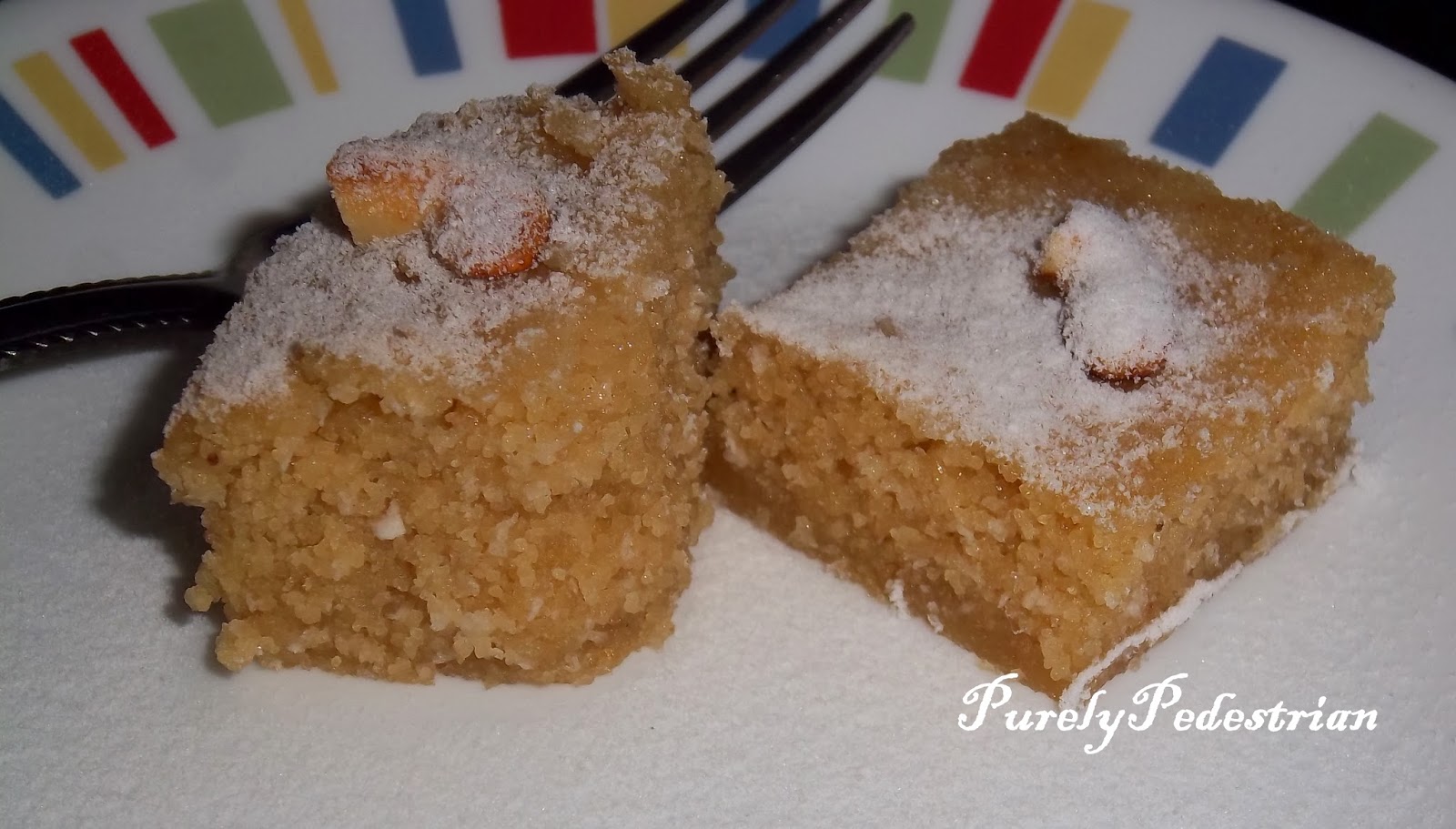
This is a simple steamed cake with semolina, coconut and jaggery with cardamom to flavor it.
Ingredients
Semolina / Rawa - 1 cup
Jaggery - 3/4 cup
Coconut - 1/4 cup
Water - 3/4 to 1 cup
Cardamom pwd - a couple of pinches
Fruit salt (Eno) - 1/4 tsp
Ghee - 1 tsp to grease the vessel
for garnishing
Caster Sugar
Cashew nuts
Raisins
Ghee - 1 tsp
Shred the jaggery and keep aside. Heat the water and add the jaggery to it and stir till it is melted. Strain the jaggery liquid and keep it aside.
In a bowl add the jaggery liquid, the semolina / rawa, the coconut and the cardamom powder and mix well. Keep this aside and heat water in the pressure cooker or steamer. Take the ghee and grease a pan or cooker vessel or a thali with it. Lower the heat when the water in the cooker or steamer starts bubbling.  Add the fruit salt or Eno into the semolina and mix and immediately pour it out into the pan or thali. Steam this for 5 minutes on high heat then reduce to medium heat and continue steaming for another 10 minutes.
Take the thali or vessel out of the steamer or cooker and let it cool. When cool run a knife around the edges and invert onto a plate.
For serving, roast the cashew nuts and raisins in the ghee and decorate the cake with it.
Fact: Semolina or Rawa is also called Farina in some places.
When we shifted to the US we got used to picking up pre-packed bags of groceries. Later we started frequenting a store that was more like a farmers market and with a lot of stuff for the local Mexican population. This store kept bins of loose grain, sugar, lentils, different types of trail mixes and pulses. They had plastic bags into which we could scoop stuff and then had to stick a sticker with the corresponding product code. This was then weighed at the counter and billed. On one of my shopping trips I found a bin that had something called farina and on looking closely discovered it to be rawa. They also had mung bean, dried red chillies, sugar dried peas in those bins and the best thing it was way cheaper than at the Indian  store. We were happy with this find because we did not frequent the Indian store that was about 12 - 15 miles away. That's my story for today!

Saturday, September 14, 2013

Sheera / Sooji ka Halwa Naivedyam

Sheera / Sooji ka halwa is often offered at pujas as prasad. Since it is Ganesh utsav, I made this for naivedyam a few days back. It is not difficult to make sheera, just stick with the measurements and after making it a few times you will be able to make it on your own.
Ingredients
Semolina / Sooji / Rawa - 1/2 cup
Ghee -  a little less than 1/2 cup
Sugar - 1/2 cup
Water - 1.25 cups
Green Cardamom - 1 crushed
Cashew nuts - 8 to 10
Raisins - 8 to 10
Almonds - 6 to 8
Heat a pan or kadhai and pour the ghee after reserving a tablespoon. When warm add the cashew nuts and sauté it till light golden then take it out onto paper towels.
Separately heat water in a saucepan and add the sugar and the crushed cardamom to it. Let it boil well. Take off the heat and keep aside.
Lower the heat and add the sooji or rawa to the pan stir continuously so that it does not burn. Sauté till light brown. Add the raisins and the fried cashew nuts to this rawa, mix well. Raise the heat and pour the sugar - water mix into the rawa, stirring all the while. When the rawa starts coming together add the ghee that was kept aside and mix well. Cover and take off the heat when all the water is absorbed. Garnish with almond slivers.
Take it into a bowl and offer it to Lord Ganesha.

Prasad

Monday, August 5, 2013

Mixed Vegetable Upma / Upumaav / Upama

Upma is one of those foods that is either really loved or absolutely detested by people, leaving hardly any fence-sitters. I do not like the upma on most days unless it is made with vegetables. For my husband it is the most comforting food that he falls back on for breakfast or lunch or dinner. But he likes it made simply, without tomatoes and vegetables which I do not eat. So at our home, if my husband is eating upma you can be sure I am eating something else! When growing up, whenever mom made upma, she cooked something else for me or made sure there was bread and cheese in the frig for me. I can live on sandwiches so her fall back plan for me was always bread with something for the stuffing!
I learnt to make an upma after marriage knowing that this was the go to dish for my husband. Its not easy to get the consistency right especially when you are starting off. Here in this post also, the measures I have given is more approximate than exact. Most of my cooking is done by the look, feel, taste and smell and I am giving you how to do it here. I prefer to add only little of what I like to call taste ingredients like salt, sugar, tamarind, chili powder, etc. initially. You can always add some later though the reverse, i.e., lessening of a taste ingredient is difficult. So be miserly at the start and add little by little as needed.

Broadly, follow these steps for making upma -
In a pan dry roast rawa on low heat till they look crisp which will take about 10 minutes, then keep aside. Heat oil in a kadai / deep pan for phodni / vagaar / tadka / tempering, add the mustard seeds and a few udad dal / split black gram. Tip, take a little more oil than required, it helps in fluffing the rawa when cooked. Once the seeds have spluttered add chopped onions, chopped green chilies and curry leaves, stir fry till the onions are soft and light golden. Add water into this and a little salt. Once it boils, lower heat and check for salt and add more if necessary. Tip, the water should taste a little saltier than you usually take in food. This is because rawa like potato absorbs salt making the upma tasteless if the water had exact salt to start with. Continuing with the upma, Raise the heat and once you have the water boiling again, slowly add the rawa into the boiling water. Add the rawa by tilting the container slightly to create a continuous flow without dumping a lot at one time. Stir the spoon in circles in one direction, mixing all the time. Do not stop stirring, lumps will form and your upma will good only for the trash can. Now, add as much rawa till the time, the mix has come together and it becomes difficult to stir the spoon. Stop adding the rawa, lower the heat and keep stirring to bring the whole mixture together. Tip, keep some boiling water handy incase you added too much rawa by mistake and incase you need to use this extra water the rule is to add little - stir well, then add more if required. If the water is all absorbed then pile all the upma into a mound then take the pan off the heat and keep covered for about 5 to 10 minutes. Then, uncover and stir the upma to fluff it up.
Mixed Vegetable Upma
Ingredients
Rawa / Sooji / Cream of wheat - approx. 1 cup
Pyaaz / Kaanda / Onion - 1 medium, finely chopped
Tamatar / Tomato - 1 small, finely chopped
Gaajar / Carrot - 2 tbsp. finely chopped
Farasbee / Beans / French Beans - 2 tbsp. finely chopped
Vatana / Matar / Green peas - 2 tbsp.
Mirchi / Hari Mirchi / Green Chili - 1 finely chopped
Rai / Mustard seeds - 1/2 tsp.
Kadipatha / Curry leaves - 2 - 3 torn into pieces (optional)
Coriander leaves - 1tsp. chopped
Water - 1.5 cups
Oil - 3 tbsp.
Salt to taste
In a pan dry roast rawa on low heat and keep aside. Heat oil tempering, add the mustard seeds and once it splutters add chopped onions, chopped green chilies. Stir fry till the onions till soft and translucent. Add the finely chopped tomatoes and fry it for a minute. Add turmeric powder, stir, then add water into this and a little salt. Add the chopped carrot, green peas and french beans and let it cook for about 5 minutes till still crunchy. Raise the heat till boiling and add the rawa slowly stirring all the while. When the mixture has come together switch off the heat and keep covered. Add the chopped coriander leaves and fluff the upma up. You can also add 1 or 2 tsp. grated coconut to this.

Spoon some into a bowl and get some piping hot tea to go with it! Enjoy!!!

The Spirituality Behind Upma

This humble dish that is a staple South Indian breakfast item won a million dollars when it was judged a winner at Top Chef Master contest in NYC. Its maker was Floyd Cardoz and the dish is called Upma - variedly called as Uppummavu in Malayalam, Uppitu or Kharabath in Kannada, Uppuma in Tamil.
 
The Malayalam term best carries the meaning of Upma; the literal meaning being 'salted flour'. And that's what it is. Made out of semolina / rawa, saamo, broken wheat / daliya, vermicelli / semiya, beaten rice / poha and most recently oats, it uses the simplest of spices and garnishes, is cooked in water, and takes only a few minutes. It is thus a paragon of culinary simplicity, a marvel of tasteful combination of ingredients, and an example of versatility and utility.
 
Upma is so common and lowly a dish that it is difficult to find a restaurant or breakfast pad that outshines the others. In terms of the pecking order of South Indian dishes, it is lower than even the dosa, idli or wada. The upma occupies the lowest place. It is always found as a single inconspicuous word in the menu and is usually available only till 10a.m. or so, in most places. So commonplace it si that if you order upma at a restaurant, most people would look at you with doubt and pity, if not scorn and disgust.
 
At home, the upma's story is even worse. Because it is so easy to make, the upma is every mother's delight and every child's woe. As a result, there are many who grow up with a lifelong hatred towards upma. The humble upma conveys many things: it signifies the housewife's lack of concern for the family members' distinguishing palate, it indicates extreme paucity of time like the entire family going out early to some place like a temple or marriage, or it shows a no-frills/ no-nonsense attitude towards treating a large number of people to breakfast.
 
There are very few genuine lovers of upma and I can count on myself being one. As I said, there are no restaurants (at least I do not know) that can take pride in serving the best upma and that is partly because the number of connoisseurs are too few. Asking a bevy of upma haters to grade an upma is wrong research methodology. Therefore, we lovers of upma, are always experimenting and are constantly seeking the best upma in town and country. We can grade them as very good ones, average and deplorable, rarely do we come across an outstanding one. Even at home the quality varies and so does your appreciation of the taste.
 
Seeking the good upma is a game of serendipity. There have been cases where I was utterly surprised by excellence and also shocked by the insipidity of the fare. Here are some spots of excellence I can remember:
1. A restaurant outside Dadar station (east) served very good upma early in the morning/ Start the day out with a warm feeling.
 
2. The famous Amba Bhavan (I think it is shut down now), which used to be next to Kochu Guruvayoorappan temple in Kings Circle, Matunga served distinctly great upma any time of the day. Wash it down with piping hot filter coffee and face the day with confidence.
 
3. In general, most standard Udipi joints in Mumbai, serve pretty good upma. But you have to be there in time for breakfast.
 
4. I have had varied experiences with upma in Bangalore. Often called as kharabhath, some of the makeshift food stalls score over the restaurants. But one restaurant called as Shilpa, bang outside Bowring Hospital, off Infantry Road, serves an outstanding fare. Most of the items in this fast-moving restaurant are par excellence. It is one of the best kept secrets in Bangalore.
 
5. Indian Coffee House in Gwalior, one or two restaurants outside Guruvayur temple in Thrissur, Kerala, Hotel Saravanas on 26th St & Lexington Ave in NYC are notable and good.
 
Great disappointments include MTR 1924 (the new one) in Bangalore, all of the South Indian restaurants in Delhi - Sagar Ratna chain. Adyar Anand Bhavan and other are disappointing. In comparison, the Naivedyam outlet in Gurgaon, scored over the others.
 
In the vein of poet Robert Browning's lines. "The best is yet to be, the last of life for which the first was made"; the quest for the best upma is an eternal one. That's the spirituality behind upma.
 
Do write in with your best choices in upma.

- ed