Showing posts with label sadhya. Show all posts

Wednesday, September 18, 2013

Semiya Kheer / Payasam

No sadhya is complete without kheer / payasam; in fact nowadays most sadhya in Kerala serves not one but two payasams - usually one milk based and the other coconut milk based. When payasam is served at a sadhya, it is served along with pappadam and pickle. It is said that having pappadam and pickle between mouthfuls of payasam helps in having some more payasam! Many people ask for the payasam to be poured on the banana leaf and then crush pappadam into it and scoop it all together. Most times it is a jaggery sweetened payasam that gets this treatment. I have never tried this but maybe sometime :)
At home, we make payasam on occasions like Onam, Vishu, and piranaals (birthdays) and it is either semiya or parippu payasam. This year for Onam, we made semiya payasam and for a change, I added saffron strands along with cardamom powder.
Ingredients
Semiya / Vermicelli - 100 gms.
Condensed milk - 1 tin (400gms)
Whole Milk - 1.5 ltr.
Sugar - 3tbsp (optional)
Cashew nuts - 20
Raisins - 20
Green Cardamom - 4
Ghee - 2tsp.
Saffron - 1/2 tsp.
Powder the green cardamom seeds finely. Warm a little milk and mix in the saffron and keep aside.
Heat a pan and add the ghee, when hot add the cashew nuts and fry till light brown. Scoop the nuts out, draining as much oil as possible and place on a paper towel. Add the vermicelli to the pan and sauté on low heat till light golden. Take off the heat and add the raisins in and stir for a minute, drain as much ghee as possible and put it on a paper towel and keep aside. 
 
Take a saucepan and boil the milk in it. Keep stirring it in between so that it does not catch the bottom. (I changed the vessel after boiling the milk because it did catch the bottom a little).  Once it boils, lower the heat and add the condensed milk and stir till it mixes completely. Add the roasted vermicelli / semiya little by little into the milk stirring all the while so it does not clump together. Add the cardamom powder as well and stir. It will take about 15 minutes for the vermicelli / semiya to cook on low heat. When the semiya has cooked, add the sugar (I added it because I found the payasam a little less sweet) and stir till mixed in. Add the saffron milk, cashew nuts and raisins and mix well. Take it off the heat. Serve hot or cooled in a frig.  
Tips:
1. Stir when adding the semiya and continue stirring in between else it will clump.
2.To powder the cardamom finely in a mortar pestle, add a teaspoon of sugar to the cardamom seeds when powdering. 
3. Sugar should be added only after the rice or semiya is cooked, else the milk may split.
4. Choose the thinnest vermicelli for payasam.

Update:
This Semiya Kheer / Payasam goes to these events
-  "Diwali Special" hosted by gayathriscookspot.
&
-  "Diwali Bash 2013" hosted by cooksjoy.

Tuesday, September 17, 2013

Mathanga Vanpayar / Pumpkin and Red Cow Peas Erissery

Erissery or Erussery is a dish served at all Kerala feasts or sadhya. It is a vegetable and dry peas combination cooked in a double coconut gravy. Like in a Do Pyaza gravy where onions are added in two forms, here also grated coconut is added in two forms! Erissery can be made with different combinations of vegetables and dry peas and some of the variations are pumpkin and red cow peas (mathanga - vanpayar), raw plantain - yam (kaaya - chenna) and jackfruit (chakka). Personally, I love the mathanga and vanpayar combination the most. The mingled flavors of a ripe sweet mathanga with the earthiness of vanpayar in a double coconut gravy, I think is a great combination. And like kids love to say, - my mother makes the best mathanga erussery that nobody in this world can beat!
 
And I have this recipe and some tips from her to make a tasty erissery :
1. Use only a ripe orange mathanga / pumpkin, nothing can beat its flavor and sweetness.  
2. Keep the quantity of the vanpayar / cow peas less than the manthanga / pumpkin.
3. Avoid stirring too much, the pumpkin will crumble.
4. And don't hold back on the coconut!
Erissery was one of the items I made for the Onam sadhya and along with the potato ishtew, they were the first ones to get over!
Ingredients
Mathanga / Pumpkin - 500 gms
Vanpayar / Red Cow peas - 1 cup
Coconut - 1
Cumin seeds - 1tsp
Curry leaves - 4 to 5 sprigs
Green chilli - 2
Dry red chilli - 5 to 6
Turmeric pwd - 1tsp
Mustard seeds - 1tsp
Salt as per taste
Oil - 2tsp
Grate the coconut and divide it into 3 portions. Take two portions of the grated coconut, add into a blender. Add the cumin seeds, 2 green chillies, 2 dry red chillies and 4 to 5 curry leaves and grind to a thick paste. Add only a few spoons of water, just enough to grind. Keep aside.
Heat a pan and dry roast the remaining one portion of the grated coconut on low heat. When cool, put into a blender and give it one whisk to roughly crush it. Keep aside.
Wash the vanpayar / red cow peas and drain. Add 1.5 cups water and boil it in a pressure cooker. Peel and dice the pumpkin and put it into a saucepan along with a little water, just enough to keep it from catching to the bottom. Add the turmeric powder and salt as per taste, cover the vessel and cook on low heat. Keep a watch on the pumpkin, it cooks quickly since it is ripe. When the pumpkin is half cooked, add 1 sprig of curry leaves and the coconut and chilli paste. Cover and cook on low heat. Check if done after about 5 minutes and add the roasted and crushed coconut to the cooked pumpkin and place a sprig or two on the top, cover and take off the heat.
Tear the dry red chilli into pieces and keep a few curry leaves ready. In a separate pan heat the oil, then add the mustard seeds and add the red chilli pieces and curry leaves, quickly stir with a spoon and take it off the heat. Pour the mix on to the erissery and cover. When ready to serve, gently mix the varthu iddal / tadka into the erissery.
 
Erusseri served on vazhayila for the Onam sadhya

Saturday, August 24, 2013

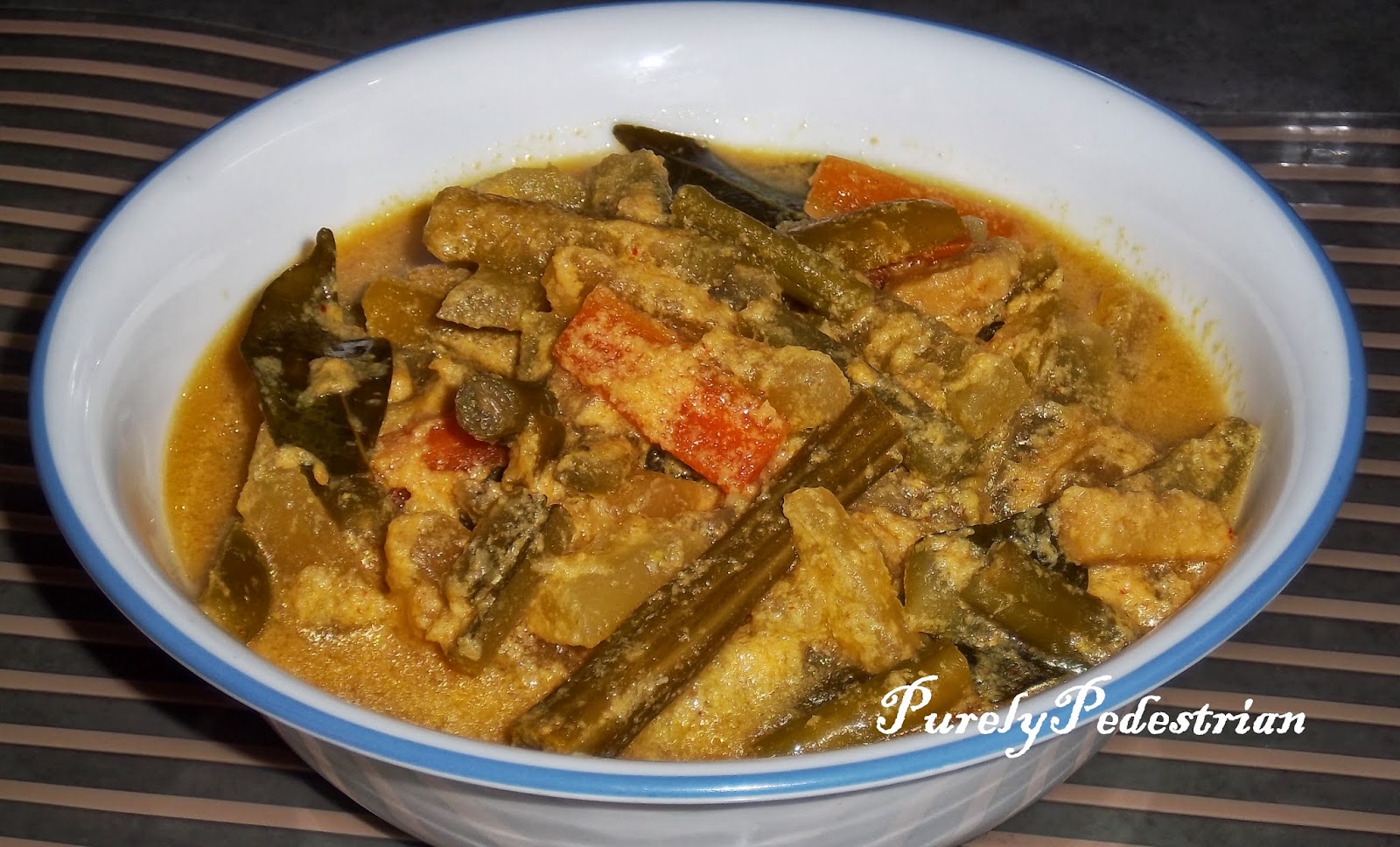
Avial / Aviyal from Kerala - a medley of mixed vegetables in coconut

Avial (aviyal), is a vegetable medley in a coconutty gravy straight from Kerala. It is a dish made on festive occasions and a sure shot item on an ela / ila sadya (feast served on a banana leaf). The avial / aviyal has many vegetables that is not used regularly in many cuisines. Many non-traditionalists use vegetables like potatoes and green peas and cauliflower in this dish which then frankly ceases to be avial and is just a vegetable curry in coconut gravy. At times, we have to substitute certain veggies due to non-availability; like most times vellarika is not available. Then either do without it or use a water heavy vege like bottle gourd or just increase the quantity of kumbalanga. Vegetables like the ash gourd, snake gourd, drumstick, yam, raw plantain (banana), yard long beans are usually the main ones that go in Avial, then additional ones like the ivy gourd, carrot, beans, eggplant are also added. This time, I did not add raw plantain to my avial because the last time it turned to be very starchy, maybe because I selected the wrong type of plantain.
 
Making Avial / Aviyal takes a little prep time. All the vegetables are cut into 1.5inch long strips with the exception of the drumsticks which are cut into 2.5inch pieces. The vegetables are added into the pot in stages since most have different cooking times else it could turn to a mushy mix. You can add either  raw mango or tamarind or curd/yogurt to add sourness to the Avial. The Avial can be made either with a little watery gravy or as a thick, no gravy dish. I chose to make it a little watery so I could avoid making another curry / kootaan. Usually, for a sadhya, the avial is made as a thick, no gravy dish without onion but when making it at home you have the liberty to do otherwise.
Ingredients
Ash gourd / White gourd /pumpkin / Kumbalanga / Kumbalengya - 1.5 cup
Bottle gourd / lauki / Churayka- 1/2 cup (use Vellarika if you get)
Yam / /Elephants foot / Chenna - 1/2 cup
Carrot - 1/2 cup
Snake gourd / Padavalanga / Padavalengya- 1/2 cup
Drumstick / Muringaka/ Muringyakay- 1
Yard long beans / Payar / Achingya - 1/2 cup
Ivy gourd / Koveka / Kovekya - 6
French beans / Beans - 1/2 cup
Fresh Curd / Yogurt - 1/2 cup
Turmeric pwd - 1tsp
Red chilli pwd - 1/2tsp
Coconut oil - 1tbsp
Curry leaves - 15
for paste
Coconut - 2 cups grated
Onion - 1/2, small sized (optional)
Jeera - 1/2tsp
Curry leaves - 2-3
Wash all the vegetables really well. Each vegetable has to be cut into strips of the same size, about 1.5inches long. For the Ash gourd / Kumbalenga, the Vellarika / English Cucumber, the Bottle gourd / Churayka and the Snake gourd / Padavalanga discard the seeds and innards and then cut into strips. Cut the Drumsticks / Muringaka into 2.5inch long pieces and make a small slit on each piece. Beat the curds / yogurt with a little water and keep aside. Grind the coconut, onion, jeera, onion to a fine paste with water, then add the curry leaves and pulse it once quickly. In case making a thick, no gravy avial, add an additional cup of grated coconut and only crush the coconut do not grind it to a fine paste and follow the rest of the recipe.
 
Put the Yam, Carrot, Snake gourd, Drumstick, Yard long beans, Ivy gourd, French beans and Bottle gourd pieces into a pot along with salt, turmeric powder and red chilli powder. Add water to the level of the veggies and close the pot with a lid and keep on low heat. Check after about 10 minutes if the vegetables are half done. Then add the Ash gourd pieces and some curry leaves and mix well and again close the lid and continue to cook on low heat. The vegetables should be cooked while retaining shape and crispness. Add the coconut paste and add little water for gravy and give it one boil. Then add the beaten curds and mix well till well blended. Do not boil after adding the yogurt. Top with the remaining curry leaves and the coconut oil and cover till ready to serve.